

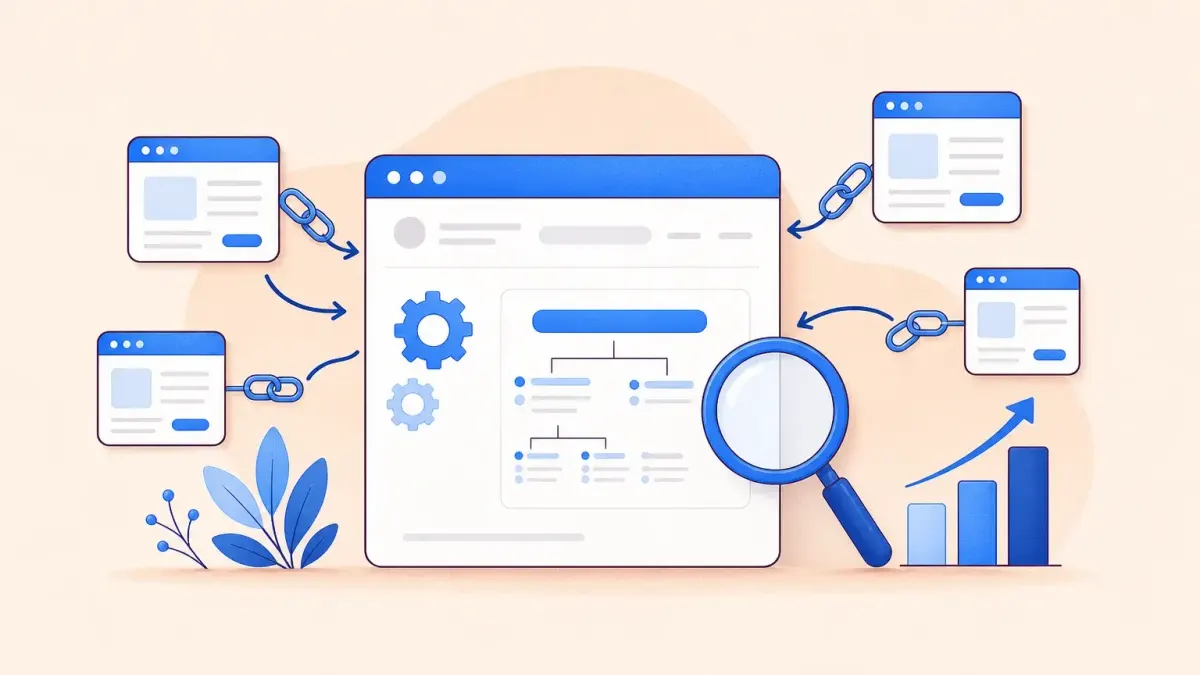
SEO (search engine optimisation) is the work that prepares a website so that Google and other search engines can find it, understand it and show it to people looking for your services or products. It has three parts: the technical condition of the website, its content and links from other websites. In this article we explain in plain terms what SEO is, how on-page and off-page SEO differ, what basic SEO covers when a website is built and why an honest specialist never promises first place on Google.
How Google finds and ranks websites
To understand SEO, it helps to know how search works. Google describes it in three stages:
- Crawling. Google’s bots visit pages and follow links to discover new ones.
- Indexing. Google analyses the text, images and structure of a page and stores the information in its index.
- Serving results. When someone searches, Google picks the pages from its index that, in its view, answer the query best.
SEO helps at every stage: it makes sure your pages are crawled, understood correctly and judged to be a useful answer. You cannot pay Google for a place in the organic search results – they depend only on the quality of a website and how well it matches the query.
On-page vs off-page SEO
All SEO work falls into two groups. On-page SEO is what happens on the website itself: technical set-up, content and structure. Off-page SEO is links, mentions and reviews on other websites.
| On-page SEO | Off-page SEO | |
|---|---|---|
| Where it happens | On your website | On other websites and platforms |
| What it covers | Technical condition, content, headings, internal links | Backlinks, mentions, reviews |
| Who controls it | You and your web developer | Partly other website owners and your customers |
| What Google learns | What a page is about and whether it is easy to use | Whether others trust your website and your business |
| When to start | First | Once the website itself is in order |
On-page SEO
On-page SEO means looking after a website’s technical condition, content and structure, so that Google understands what each page is about and visitors quickly find their answer. This is where SEO starts, because all of this work is within your control.
Technical SEO
The technical side makes sure Google can crawl a website without obstacles and include it in search. It covers:
- a secure HTTPS connection;
- a clear page structure and readable URLs;
- a sitemap and correct 301 redirects;
- important pages not blocked from indexing (robots.txt, noindex);
- no broken links or duplicate pages.
Keywords and content
Content means your text, images and their descriptions. Google recommends writing for people, not for search engines: clearly, usefully and in the words your customers actually search with. That is why the work starts with keywords – finding out how people phrase their searches about your services. If your customers search in Lithuanian, each language version of your website needs its own keywords.
Each important topic then gets its own page. When two pages cover the same thing, they compete with each other, and Google finds it harder to choose which one to show.
Title, description and H1–H3
People see a page’s title and meta description in the search results before they open your website. The title should be short, roughly up to 60 characters, and start with what people are searching for. The description does not directly improve rankings, but it decides whether someone clicks on your result rather than another.
A page should have one H1 heading, with sections marked by H2 and H3 headings – this makes the text easier to read for both visitors and Google. Images get alt text that briefly says what they show. The meta keywords tag, on the other hand, has not been used by Google for a long time, so there is no need to fill it in.
Internal links
Internal links are links between pages of your own website. They help Google discover new pages and understand which ones matter most, and they help visitors move on to related information. The link text should say where it leads: ‘website prices’ is clearer than ‘click here’. Every important page should be reachable from the menu or from another page, rather than left with no links pointing to it.
Speed and mobile-friendliness
Google indexes websites based on their mobile version, so the phone version should show the same content as the desktop one. Google measures speed and usability with Core Web Vitals: how quickly the main content appears, how quickly the page responds to a tap or click and whether elements jump around while it loads. You can check them with Google’s PageSpeed Insights tool. The most common causes of a slow website are oversized images and unnecessary plugins.
Structured data (schema)
Structured data is extra code on a page, usually based on the schema.org vocabulary. It tells Google precisely what is what: your company name, address, opening hours, a product price or an article date. It does not directly improve rankings, but it helps Google understand the page correctly and can enrich your search result, for example with a product price.
On-page SEO is not a one-off job. When you add new services or change prices, pages need updating and broken links need fixing. You can do this yourself or leave it to website maintenance.
Off-page SEO
Off-page SEO is the work done outside your website: links to it from other sites, mentions of your company and reviews. They show Google that others trust your website and your business. Off-page work only pays off once on-page SEO is in order: a link to a slow or unclear page changes very little.
Backlinks: quality over quantity
A backlink is a link from another website to yours. Google treats it as a recommendation, so it matters who is recommending you. One link from a respected portal in your industry, a partner or a news article is worth more than dozens of links from random websites. Natural links appear when you have something worth pointing to: a useful article, practical advice, examples of your work.
Bought links, excessive link exchanges and networks of sites created only for links break Google’s spam policies. Google may ignore such links or lower your website’s visibility in search. We do not buy links and we do not use black-hat SEO.
Mentions, reviews and directories
A mention is useful even without a link. If your company name, address and phone number are written the same way everywhere – on your website, in your Google Business Profile and in directories – search engines find it easier to connect this information with your business. Reviews help customers decide and help Google confirm that the business really exists. Do not buy reviews or write them yourself: this breaks Google’s rules.
Be present where customers actually look: the main business directories, the websites of your industry associations and partners, and social media. Signing up to hundreds of link directories just for the link no longer brings any benefit.
Finding such places and working on them consistently is part of full SEO optimisation. How we do it is described on our SEO services page.
What basic SEO covers when a website is built
When we build a website, basic technical SEO is already included in the price. Every page gets:
- a page title, which Google shows in the search results;
- a meta description – the short text below the title;
- a clear H1–H3 heading structure;
- alt text for images.
On top of that, every new website works on phones and tablets. This is a solid foundation: the website is technically ready for Google to understand it. What else building a website involves is described on our website development page.
Basic SEO vs full SEO optimisation
Basic SEO puts the technical side in order, but it does not answer which searches you need to appear for or how to get ahead of competitors. That is what full SEO optimisation is for – a separate service.
| Basic SEO | Full SEO optimisation | |
|---|---|---|
| When | While the website is built | Separately, with a new website or later |
| Title, description, H1–H3, alt text | Yes | Yes, based on keyword research |
| Keyword research | No | Yes |
| Competitor analysis | No | Yes |
| Plan of work | No | Yes |
| Tracking results, new content | No | If you work with us monthly |
Full SEO optimisation can be a one-off project – with research, a competitor review and a plan – or ongoing monthly work: checking results, writing articles and fixing whatever the data points to. Ordered together with a new website, it usually adds about 20–25% to the cost of building it. What it includes and what it costs is on our SEO services page.
When to start with SEO
SEO costs least when you think about it while the website is being built. If the page structure is planned around what customers search for, you will not need to rework the menu, change URLs or rewrite copy later.
It is especially important not to forget SEO when an old website is replaced with a new one. If old page addresses disappear without redirects, Google treats them as broken, and the website can lose some of its visitors from search. That is why, when a new website replaces an old one, every old address gets a 301 redirect to the matching new page. We describe this on our website redesign page.
SEO mistakes to avoid
Some ‘quick fixes’ do more harm than good. Google names most of them in its spam policies:
- Keyword stuffing. The same word repeated dozens of times makes the text unreadable and does not help in search.
- Bought links. Buying links to improve rankings breaks Google’s rules.
- Copied content. Text copied from other websites has no value for readers or for search.
- One page for every service. When everything is on one page, Google finds it harder to tell which search it answers.
- Hidden text. White text on a white background or hidden keywords is an old trick that Google recognises.
Why nobody can promise a place on Google
Google’s own guidance says clearly that nobody can ensure a number one ranking on Google, and it advises caution with anyone who makes such promises.
The reasons are simple:
- Google controls the algorithms. They are updated constantly, and the exact ranking criteria are not published.
- Competitors are working too. Your position also depends on what other websites do.
- Results differ. The searcher’s location, device and wording all change what they see.
What can honestly be promised is a clear plan of work and measurable indicators. With Google Search Console you can track how often your website appears in search, how often it is clicked and which searches it is found for. The first changes usually appear after a few months rather than straight away.
What you can do yourself
You can handle part of the SEO work without a specialist:
- describe each service clearly on a page of its own;
- write in the words your customers use when they search;
- add short, meaningful descriptions to your images;
- keep information up to date – prices, your work, contact details;
- connect Google Search Console and review the data at least once a month.
Once this is done and competition in your field is strong, it makes sense to bring in a specialist who will draw up a plan and help you put it into practice.
If you would like to know what your website needs, tell us about your business – we will suggest where to start.
Published .
Sources
- Google Search Central – Do you need an SEO? (external website)
- Google Search Central – SEO Starter Guide (external website)
- Google Search Central – In-depth guide to how Google Search works (external website)
- Google Search Central – Spam policies for Google web search (external website)
- Google Search Central – Mobile-first indexing best practices (external website)
- Google Search Central – Introduction to structured data markup (external website)