

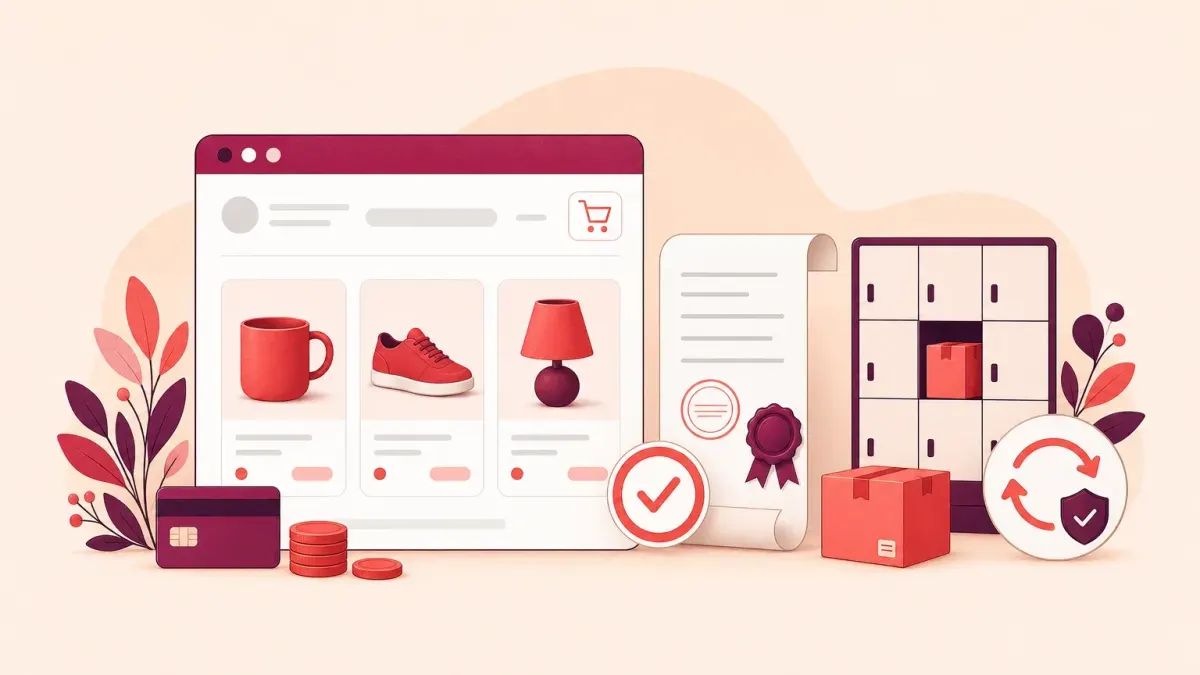
To start an online store in Lithuania, you need to register a business (individual activity, a small partnership or a private limited company), know when you must register for VAT with the State Tax Inspectorate (VMI), publish your seller details, terms of sale, returns policy and privacy policy on the website, and then connect payments and delivery. The shop website itself is only one part of the job. Below we go through what an online shop needs, step by step, to trade by the rules.
How to start an online store: 6 steps
- Choose a business form – individual activity under a certificate, a small partnership (MB) or a private limited company (UAB).
- Check your VAT position – whether you will reach the registration threshold and whether you will buy goods from other EU countries.
- Prepare the documents – terms of sale, returns policy, privacy policy and cookie policy.
- Choose a payment provider – for example, Paysera or Montonio – and sign a contract with them.
- Choose delivery methods – parcel lockers, courier or collection in person.
- Build and test the shop – the catalogue, basket, payment and order handling.
Business form: individual activity, MB or UAB
You can sell online as a private individual or through a company. The choice depends on your turnover, your risk and whether you will work alone.
| Criterion | Individual activity | MB (small partnership) | UAB (private limited company) |
|---|---|---|---|
| Where to register | VMI (via Mano VMI) | Register of Legal Entities (Registrų centras) | Register of Legal Entities (Registrų centras) |
| Capital | Not required | No minimum capital | Share capital of at least €1,000 |
| Liability | All your personal assets | Limited to the partnership’s assets | Limited to the company’s assets |
| Suits | Testing an idea, small-scale selling | One or a few owners | Larger businesses, investors |
The simplest way to start is individual activity (individuali veikla): you order the certificate in Mano VMI and can start selling straight away. An MB suits a small business well: no share capital is needed, and your personal assets are kept separate from the business. A UAB fits if you plan to bring in investors or have many shareholders. It is worth discussing the choice with an accountant, as it affects your taxes and bookkeeping costs.
Online shops and VMI: when to register for VAT
Many online shops start without being VAT-registered. Registration for VAT (PVM in Lithuanian) is mandatory when income from VAT-taxable activity exceeded €45,000 in the previous calendar year or is expected to exceed it in the current year. Under the rules in force since 1 May 2025, VAT is charged from the transaction that took you over the threshold. Raising the threshold has been proposed, so check the current amount on vmi.lt before you decide.
There is one more case when you must register: when you buy goods from VAT-registered suppliers in other EU countries for more than €14,000 (excluding VAT) in a calendar year. This applies to shops that buy stock from, say, Polish or German suppliers. You can also register for VAT voluntarily – for example, if most of your customers are businesses.
Selling to other EU countries
If you sell to consumers in other EU countries, there is a single threshold of €10,000 a year for all countries together. Below it, Lithuanian VAT applies. Above it, the VAT rate of the buyer’s country applies, and you can declare the tax through the EU One-Stop Shop (OSS) instead of registering in each country separately.
What an online shop website must include
In an online shop, the buyer cannot inspect the goods or talk to the seller, so the law requires all the key information to be on the website before the order is placed.
Seller details and final prices
The website must show the seller’s company name or personal name, the company code or individual activity certificate number, the address, email and phone number. A VAT-registered seller also shows its VAT number. Prices for consumers are shown as final prices including all taxes, and the delivery cost must be clear before the order is paid for.
Terms of sale
The terms explain how the contract is made, how customers can pay, which delivery methods and times are available, how to make a complaint and what warranty applies to the goods. The buyer must be able to read the terms before placing an order, which is why checkouts usually have an ‘I have read the terms’ tick box.
The 14-day right of withdrawal
A consumer can withdraw from an online purchase within 14 days of receiving the goods without giving a reason. Your terms must explain this right and the returns procedure, and it is good practice to include a withdrawal form. The right does not apply to made-to-order goods, perishables or unsealed hygiene products.
Privacy policy and cookies
An online shop processes customers’ personal data: names, addresses, phone numbers and order history. Under the General Data Protection Regulation (GDPR), the website needs a privacy policy explaining what data is collected, who it is shared with (for example, the courier or payment provider) and how long it is kept. If you use analytics or marketing cookies, you need the visitor’s consent before setting them.
Accessibility for people with disabilities
Since 28 June 2025, e-commerce services have been covered by the European Accessibility Act: customers must be able to use the shop with a keyboard and with a screen reader. Microenterprises that provide services do not have to meet these requirements. Read more in our article on what the European Accessibility Act means for online shops.
Payments: how customers will pay
The usual ways to pay in an online shop are online banking and bank cards. Payment providers such as Paysera, Montonio, PayPal or Stripe offer both through a single system. You sign a contract with the provider you choose, and it charges a fee per transaction, so compare the terms against your expected number of orders and average order value.
Before connecting payments, it helps to have your terms and seller details already published on the website, as the payment provider may ask for them. Connecting payments to a shop costs from €150 when ordered separately.
Delivery: parcel lockers and couriers
Parcel lockers (paštomatai) are very common in Lithuania: the buyer chooses a convenient locker at checkout and collects the parcel at any time. LP EXPRESS, Omniva, DPD and other carriers run locker networks. Besides lockers, you can offer door-to-door courier delivery and collection in person.
When delivery is connected to the shop, the buyer picks a locker on a map or from a list, and you create the parcel label straight from the order. A delivery integration costs from €150 when ordered separately.
What our online store development includes
We can build a shop where all of this works together. Our ecommerce website development service includes:
- a product catalogue with categories, filters and search;
- a basket, order management and customer accounts;
- connecting payment and delivery methods;
- terms of sale, returns and privacy policy pages with the texts you provide;
- a design that works on phones and tablets;
- basic technical SEO: page titles, descriptions and alt text.
Building an online shop costs from €999, and takes 1–3 weeks. You will find all packages on our prices page. Before launch we test ordering and payment, and after launch we show you how to manage products and orders.
If you are planning to open an online shop, tell us about your products and plans – we will suggest a solution and work out the price.
This article is general information, not legal or tax advice. Amounts and rules can change, so talk to an accountant and check the current information on vmi.lt before you start trading.
Published .
Sources
- VMI – When does the obligation to register for VAT arise? (in Lithuanian) (external website)
- VMI – VAT Act amendments from 1 May 2025 (in Lithuanian) (external website)
- Your Europe – Returning goods and the 14-day right of withdrawal (external website)
- European Commission – VAT One-Stop Shop (OSS) (external website)
- General Data Protection Regulation (EU) 2016/679 (external website)
- European Accessibility Act (Directive (EU) 2019/882) (external website)